Rooted structure
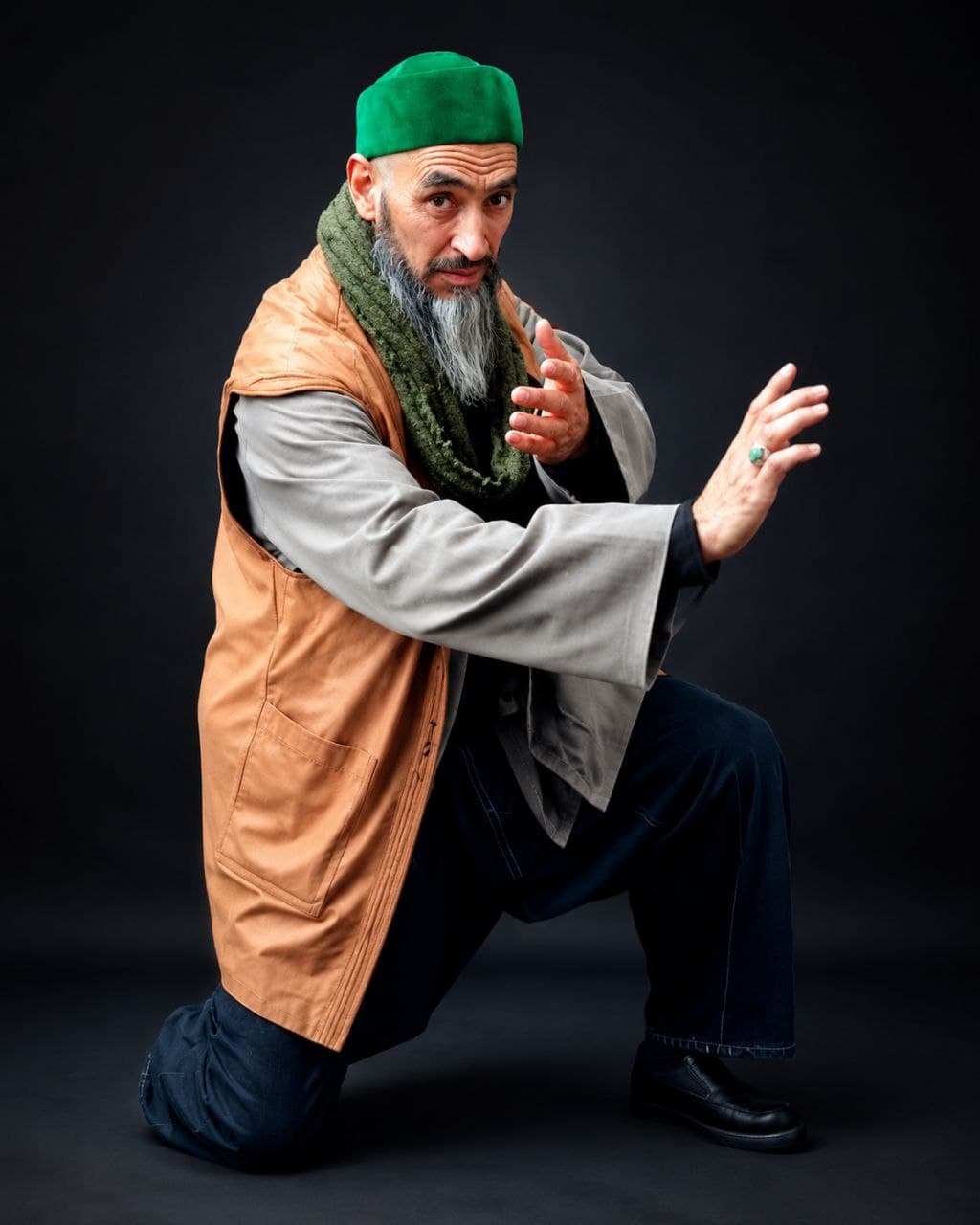
In the Tarikolot teaching described by Master Abdur Rahman, the body stays compact and connected. The stance is low and stable, the hands stay close to the body, and the elbows remain organised rather than opening without purpose.
Tarikolot, West Java
A living martial tradition in which fighting skill, breath, character, faith and responsibility are trained as parts of one inheritance.
Silat Cimande Asli Tarikolot is a traditional Pencak Silat transmission associated with Tarikolot in Bogor, West Java. In the United Kingdom it is taught through Master Abdur Rahman Blanchette, who describes his connection to the art through direct training in Tarikolot under Bapak Firdaus and authorisation connected with that training.
The art is practical and close-range, but its purpose is broader than fighting alone. The transmission taught by Master Abdur Rahman brings together structure, Igel, Pancer, breath, conditioning, adab, Islamic devotion and the traditional Cimande responsibility to understand how the body may also be cared for and restored.
Asli and Pancer
Master Abdur Rahman explains the word Asli through Pancer: the core, centre or organising identity of the transmission.
In the lineage account he received, preserving Pancer means more than keeping old names. It means retaining a recognisable body method, teaching relationship and ethical frame. The movements stay compact, the steps stay purposeful and the art is not casually rearranged simply because another method looks faster or more fashionable.
In the Tarikolot teaching described by Master Abdur Rahman, the body stays compact and connected. The stance is low and stable, the hands stay close to the body, and the elbows remain organised rather than opening without purpose.
The footwork is described through the idea of returning to the centre. Movement is economical, close-range and functional rather than expanded for display. The aim is to preserve balance, structure and the ability to respond immediately.
Abdur Rahman explains Asli through Pancer: keeping the core identity of the transmission rather than casually mixing it with other systems. This is a lineage principle, not a claim that every other branch of Cimande is false or inferior.
A transmitted Tarikolot account
In the lineage history taught to Master Abdur Rahman, Abah Haji Abdulshamad is remembered as an important Tarikolot figure whose inheritance is associated with three recurring themes: preservation of the art, a strong Islamic identity and the responsibility to heal as well as fight.
This website presents those details as transmitted lineage history. Spellings, dates and the exact relationship between different Cimande organisations are still being documented carefully rather than being simplified into claims that cannot yet be supported.
Living transmission
Tarikolot represents a village environment, teachers, families, etiquette, training culture and responsibility. The name identifies a specific living connection with West Java rather than functioning as a generic label for every form of Cimande.
The public teaching in the United Kingdom is centred on Master Abdur Rahman Blanchette. We describe his connection through his first-hand account and the records associated with his training, while continuing to document the wider teacher-to-teacher lineage with care.
Nafas, Latihan and Batin
Tenaga Dalam is often translated as inner power or internal energy. In this Tarikolot teaching it is not presented as magic, a supernatural shortcut or a paid activation.
Master Abdur Rahman explains development through three things working together: breath, a body changed by training and inner discipline. A useful comparison can be made with Chinese Qigong, but the Tarikolot practice has its own Indonesian and Sundanese vocabulary and its own cultural setting.
Breath is used to settle the body, organise effort and cultivate composure. Abdur Rahman uses the Tarikolot term Nafas Sareh for calm, controlled breathing. He describes belly-led breathing rather than shallow chest breathing, practised as part of training rather than as a separate commercial product.
Internal development is inseparable from physical training. Stance work, Igel, partner contact, body conditioning and repeated technical practice gradually change strength, resilience, coordination and the ability to remain composed under pressure.
In the Tarikolot line taught by Abdur Rahman, the inner dimension is explicitly Islamic. It includes intention, adab, doa and zikir, with devotional practice and moral discipline understood as part of how martial knowledge should be carried.
Terms such as Isian and Kawisesan also appear in the Tarikolot vocabulary described by Master Abdur Rahman. They belong to later, teacher-led material and are not presented here as techniques that can be separated from the wider training relationship.
The older curriculum
In Master Abdur Rahman's transmitted account of the Abdulshamad line, the older curriculum is remembered as 28 Igel learned one after another under direct supervision. Progress was not organised around belts or a fast written syllabus. The teacher watched the student and decided when another part of the art should be given.
Different Cimande organisations today use different curriculum counts and structures, including traditions that describe 33 jurus. We do not use that difference to declare other branches false. It is an important part of Cimande history that we are documenting with Master Abdur Rahman so that the differences can be explained accurately.
What remains consistent in his description of the older method is the character of the training: compact movement, short steps, close-range protection, strong structure, conditioning and a slow teacher-led progression rather than performance for its own sake.
Training method
Cimande is learned through repetition, correction, contact and time. Technical movement, breath, conditioning and conduct develop together.
In Abdur Rahman's transmitted account, the older Abdulshamad curriculum is remembered as 28 Igel learned progressively under a teacher. They train posture, protection of the centre, striking lines, coordination, timing, intent and close-range structure. The full sequence is treated as a living curriculum, not simply a list to copy from a page.
Stepping trains angle, balance, recovery and position. In this teaching, movement repeatedly returns to an organised centre. Hands and feet are not separated: the whole body learns where to be, how to enter, how to leave and how to recover.
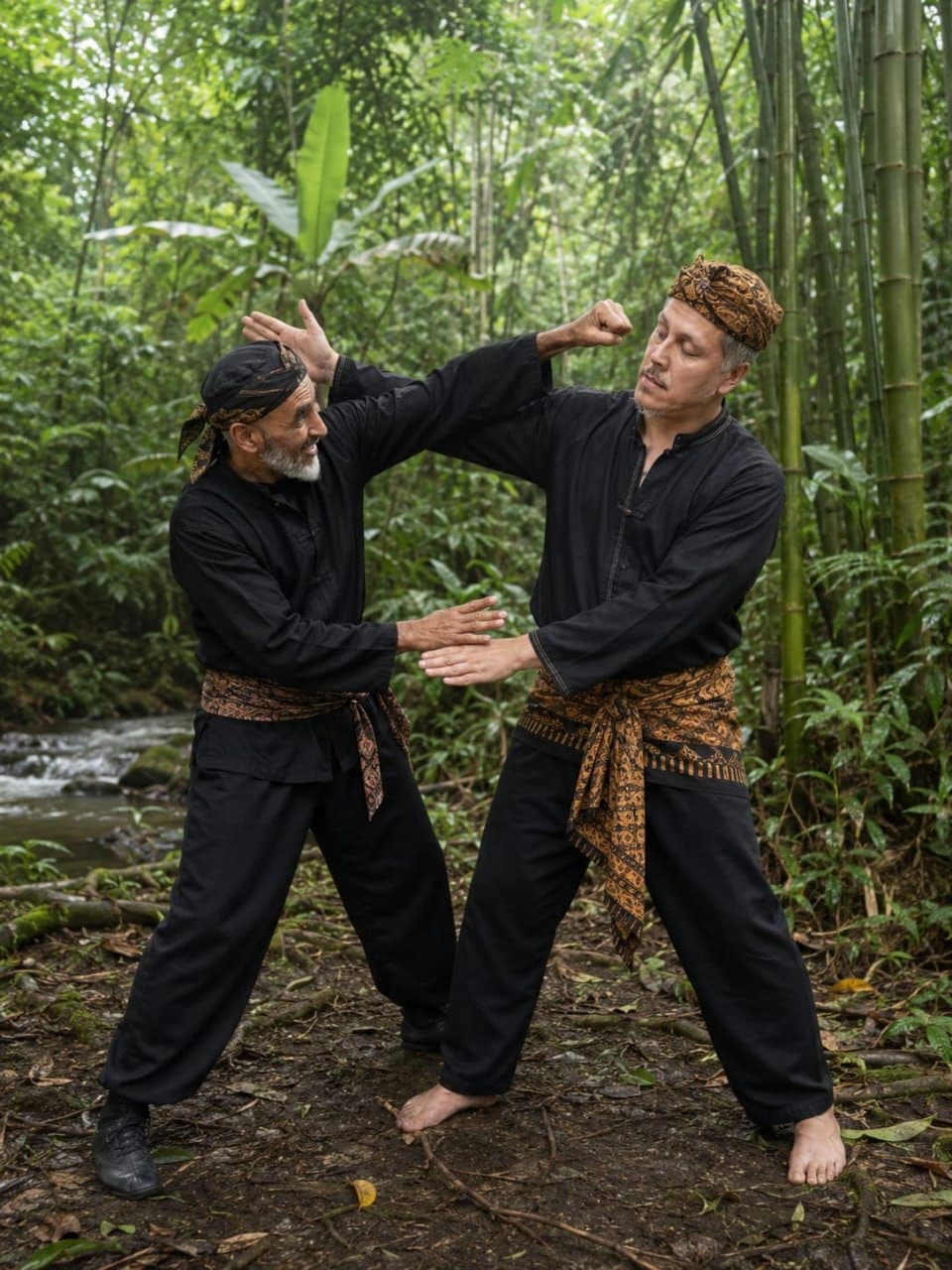
Contact training develops sensitivity, timing, pressure, control and practical response. Conditioning is not treated as mindless impact. It develops progressively through supervised work, partner contact and recovery practices, with care for the training partner built into the method.
Abdur Rahman's account describes conditioning as embedded in the art rather than taught as a separate spectacle. Older methods used work, touch, massage, oils and, at later stages, locally available agricultural materials such as tiwu, or sugar cane. Detailed methods remain teacher-led and are not presented here as unsupervised exercises.
Talek, Islam and adab
In the Tarikolot transmission described by Master Abdur Rahman, martial knowledge is held inside an explicitly Islamic ethical and devotional framework.
He describes Talek as more than a rule sheet. It binds skill to behaviour, responsibility and relationship. Doa, zikir, intention and proper conduct belong to the training environment, alongside the physical practice of the art.
The purpose is not to make martial ability mysterious. It is to remind the practitioner that the ability to hurt another person creates a greater obligation to exercise judgement, restraint and care.
A martial art with a healing inheritance
Cimande is traditionally associated in West Java not only with fighting, but also with massage, oils, injury care and bone-setting.
In Master Abdur Rahman's account of the Abdulshamad line, healing is not an unrelated extra. Martial training develops knowledge of structure, joints, pressure, balance and the effects of force. The tradition also asks the practitioner to learn care, recovery and responsibility for the body.
The wider Cimande inheritance includes traditional massage, oils, care for strains and sprains, and a longstanding reputation for bone-setting. These practices form part of the cultural history of the art.
They are not presented on this website as a replacement for modern medical diagnosis, emergency treatment or regulated clinical care.
Abdul Rahman's account repeatedly joins conditioning with recovery: the body is trained, contact is developed, and care for the partner follows. That principle is more important publicly than reproducing restricted conditioning methods without a teacher present.
Why this matters today
The value of Silat Cimande Asli Tarikolot is not that it promises secret powers. Its depth comes from the way different parts of the training support one another: structure gives technique substance, breath supports composure, conditioning changes the body, Talek and adab govern behaviour, and healing knowledge places force inside a wider responsibility.
For a modern martial artist, this offers a serious close-range method without stripping away the culture that gave the method meaning. For a student seeking traditional Silat, it offers a living relationship with teachers and a source community rather than an invented syllabus marketed as ancient simply because it looks exotic.
Train or host
Regular training is based in East London. National and international seminar enquiries are also considered where the group, venue and purpose are suitable.
Email: seminars@silatcimandeasli.com
WhatsApp: +44 7535 725720
When enquiring, include
Common questions
Silat Cimande Asli Tarikolot is a living West Javanese Pencak Silat transmission associated with Tarikolot, Bogor. The teaching presented here combines practical close-range martial skill with Pancer, disciplined training, breath, adab, an Islamic devotional framework and the wider Cimande inheritance of healing knowledge.
Master Abdur Rahman explains Asli through the idea of Pancer, preserving the core identity and principles of the transmission. In his account this includes compact structure, short purposeful stepping, close-range application and resistance to casually mixing the art with unrelated systems.
In the lineage history transmitted to Master Abdur Rahman, the older Abdulshamad curriculum is described as 28 Igel learned progressively under a teacher. Other Cimande organisations use different syllabus structures and counts, so the website does not present 28 as a universal rule for every Cimande branch.
Tenaga Dalam is an Indonesian expression often translated as inner power or internal energy, but Master Abdur Rahman does not present the Tarikolot work as magic or simply rename it Qigong. He explains development through Nafas, Latihan and Batin: breath, trained body and inner discipline. Qigong can be a useful comparison for readers, but it is not the indigenous name of the Tarikolot material.
Nafas Sareh is the term Master Abdur Rahman uses for calm, controlled breathing in the Tarikolot teaching. It is used to settle the body, organise effort and develop composure. It belongs inside the wider martial practice rather than being sold as a separate activation or shortcut.
The specific line described by Master Abdur Rahman is explicitly Islamic in its ethical and devotional framework. He describes Talek, adab, doa and zikir as part of the transmission and associates the Abdulshamad line with a strong Islamic identity. This does not mean every historical Cimande branch has used identical devotional forms.
Yes. Cimande is traditionally associated in West Java with massage, oils, injury care and bone-setting traditions as well as martial practice. This website presents that healing inheritance as cultural and martial knowledge, not as a substitute for modern diagnosis, emergency care or regulated medical treatment.
The public teaching in the United Kingdom is centred on Master Abdur Rahman Blanchette, also known as Nicholas Blanchette. He describes his Cimande Asli Tarikolot teaching as coming through direct training in Tarikolot under Bapak Firdaus, together with authorisation connected with that training.
People without previous Silat experience may enquire. Training is gradual and teacher-led, and attendance or progression is confirmed directly rather than assumed automatically from an online application.
Yes. Suitable seminar enquiries are welcomed from the United Kingdom and internationally. Hosts are asked to provide clear information about the group, venue, purpose, participant numbers and practical arrangements before a date is treated as confirmed.